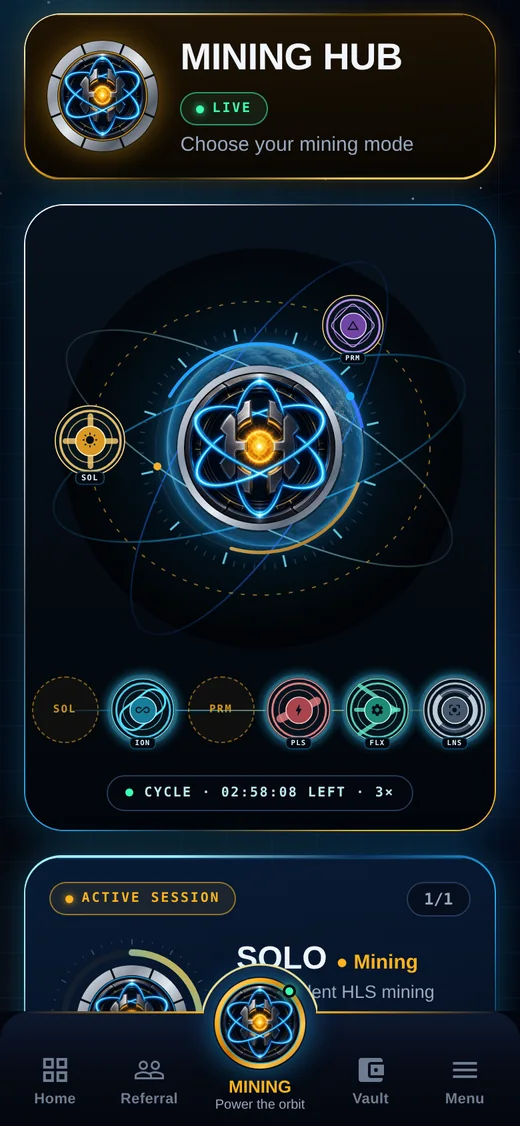
Ignite the core
Tap to start a 4-hour mining cycle. Your core charges on the server clock, so it keeps running even when the app is closed.
ENTERING ORBIT · ANDROID LAUNCH INCOMING
Ignite your core. Launch boost orbs. Climb the ranks of a network built around you showing up. The Helios mining app is in final testing, and the first orbit is about to open.
THE LOOP
No farms to babysit and no hardware to run. Open Helios, power your core, and let the orbit do the work. Come back when the cycle completes and collect.
Tap to start a 4-hour mining cycle. Your core charges on the server clock, so it keeps running even when the app is closed.
Six boost orbs wait in your launch bay. Touch one and it rockets into orbit around your core, adding +1× to the cycle.
When the timer hits zero, collect. Stack all six orbs for 7× and a full cycle pays 28 HLS instead of 4.
Every cycle pushes your Orbit Rank higher, from Nova up through Pulsar and beyond. Streaks and daily bonuses keep the climb moving.
THE APP
A living orbital core. Boost orbs that you actually launch. A command deck that shows your streak, your referrals, and your rank at a glance. Helios was designed so opening it is part of the reward.
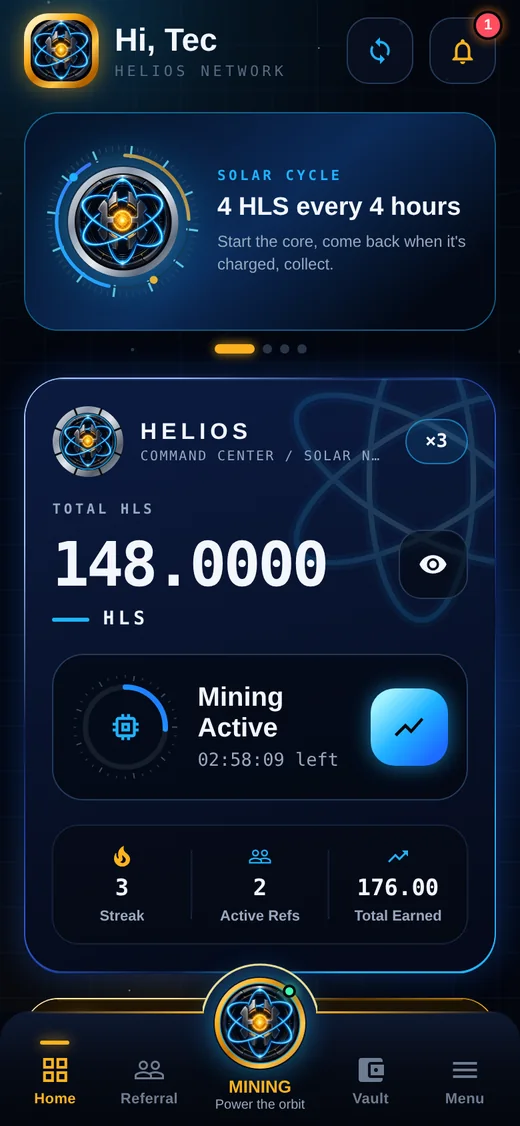
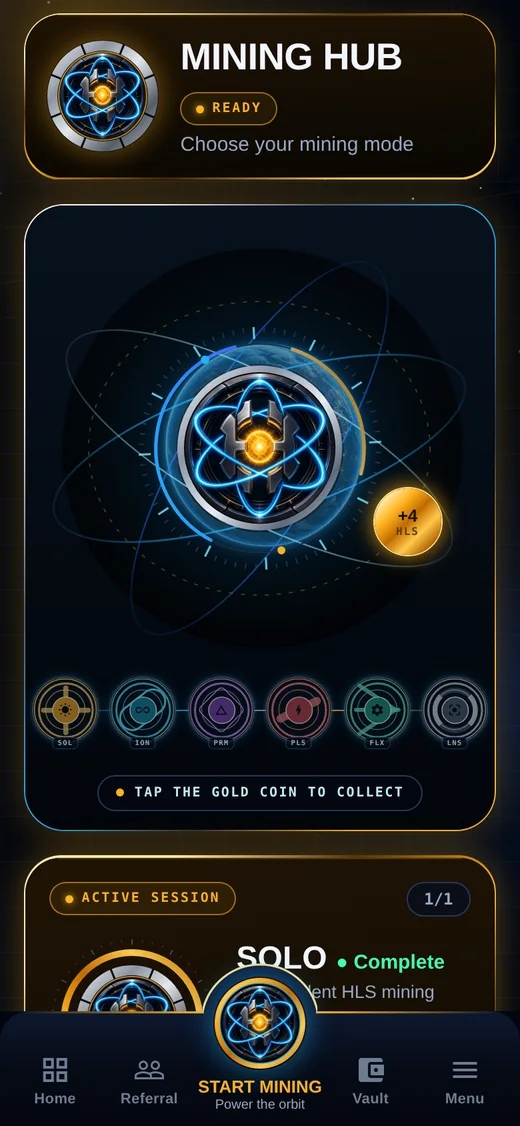
App screens shown with sample data from a preview build.
COMING WITH APP LAUNCH
The earliest members of Helios get something nobody who joins later can buy. Founder access opens in limited waves when the app goes live, and each wave closes for good.
One-time. Lowest price. Ever.
A small, numbered first group. Once the last pass is claimed, wave 1 is gone and the price only goes up.
Pricing and pass count announced at launchOne-time. A larger group.
The second wave opens to a bigger group at a higher one-time price. After this, founder access closes.
Pricing and pass count announced at launchLaunch your orbs instantly. Founders skip the video step on every boost.
A permanent Founder badge on your profile, in your Command Center, and across the network.
Early looks at new features, new orbs, and new programs before anyone else sees them.
Your pass is planned to carry over as a Founder NFT: a collectible key that unlocks these perks and travels with your wallet.
And after the founder waves: Helios Plus, a renewable membership with the same ad-free boosts and more. Details land closer to launch.
COMMAND CENTER
Sign in on the web with the same email and password you use in the app. Your cycles, boosts, balance, and activity are one record, kept by the Helios service rather than rebuilt in your browser.
Watch the live cycle, boost multiplier, and collect window.
Open ↗ 02 · REWARDSEvery confirmed reward event, balance, and streak in one place.
Open ↗ 03 · ACCESSSee your ad-free and founder access the moment it is granted.
Open ↗ 04 · CREWTrack the members you brought into orbit.
Open ↗Create your account in the app first, then sign in here. New accounts begin at zero, and rewards appear only after the Helios service records a verified action.
LAUNCH TRAJECTORY
Honest status, no countdown theatre. Here is where Helios stands and what comes next.
The Helios app is built with live mining, boost orbs, rewards, and the Command Center connected to one shared service.
The app is on Google Play internal testing now, being hardened on real devices.
A wider group of testers flies the app before the public does.
Helios goes live on Google Play and Founder access opens in waves.
Helios Plus, the Founder NFT rollout, and a planned path from in-app HLS toward tokenized $HLS, each subject to review before it ships.
$HLS
In the app, HLS are virtual credits you build up by mining. The $HLS network design below is the long-term framework for participation and stewardship. It is an informational design, not a claim about value.
Helios’s proposed coordination unit
Network emissionsLong-term participation and coordination programs
34%Ecosystem and developer grantsSupport for useful application and builder activity
22%Community treasuryStewardship and collective ecosystem resources
18%Core contributorsSubject to transparent, long-term vesting design
14%Strategic liquidityOperational resilience and approved market infrastructure
8%Early supportersSubject to a defined release framework
4%
THE ORBIT IS OPENING
Create your account the moment the app lands, claim a place in the first wave, and start your core. Your Command Center will already be waiting.